You’ve suspected onion for two years.Settle it in 22 days.
One food. A fixed window. Then it comes back in, to check it really was the food. Gutli reads the meals and symptoms you are already logging, accounts for the bad weeks, and tells you what it found — including when it doesn’t know.

For iPhone. Sign in with Apple.
Low FODMAP preview · Coming soon
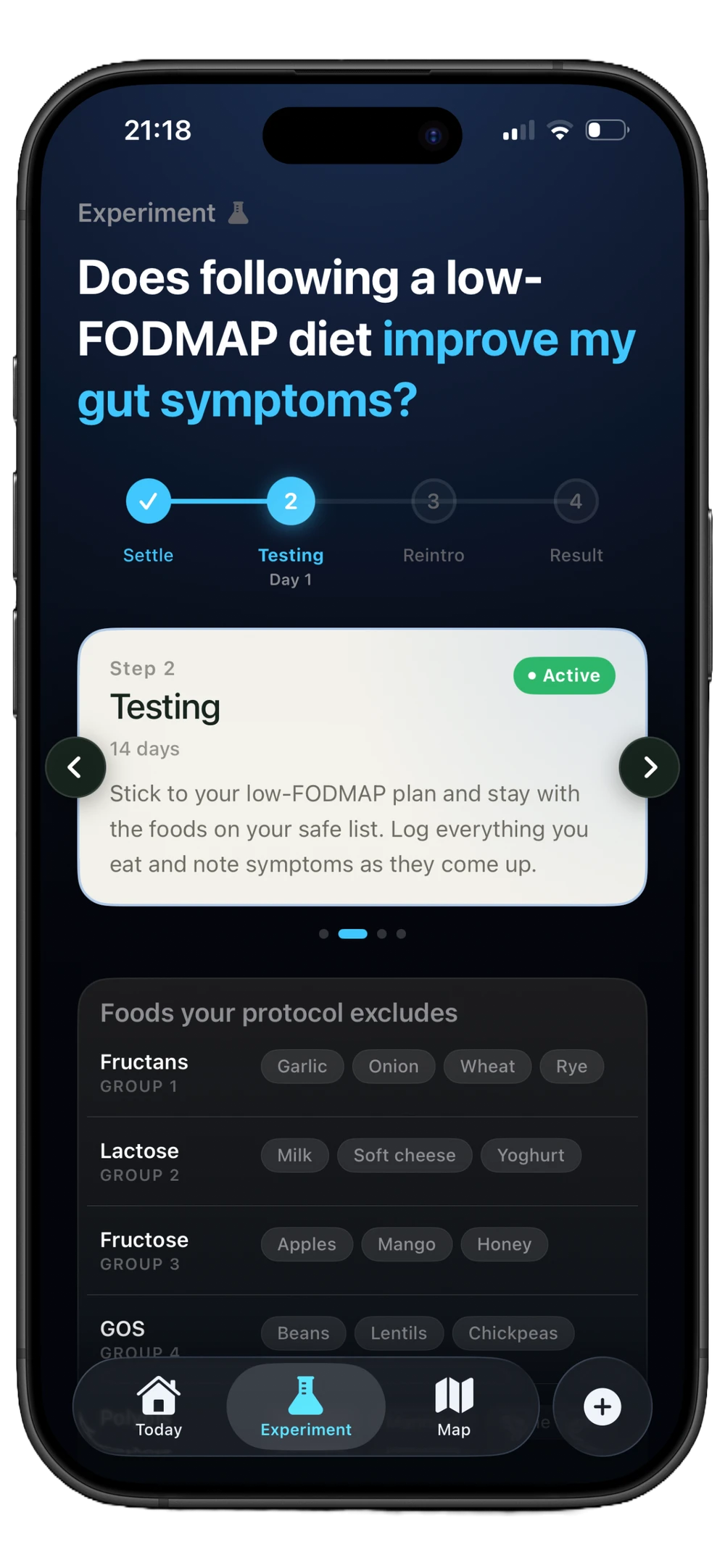
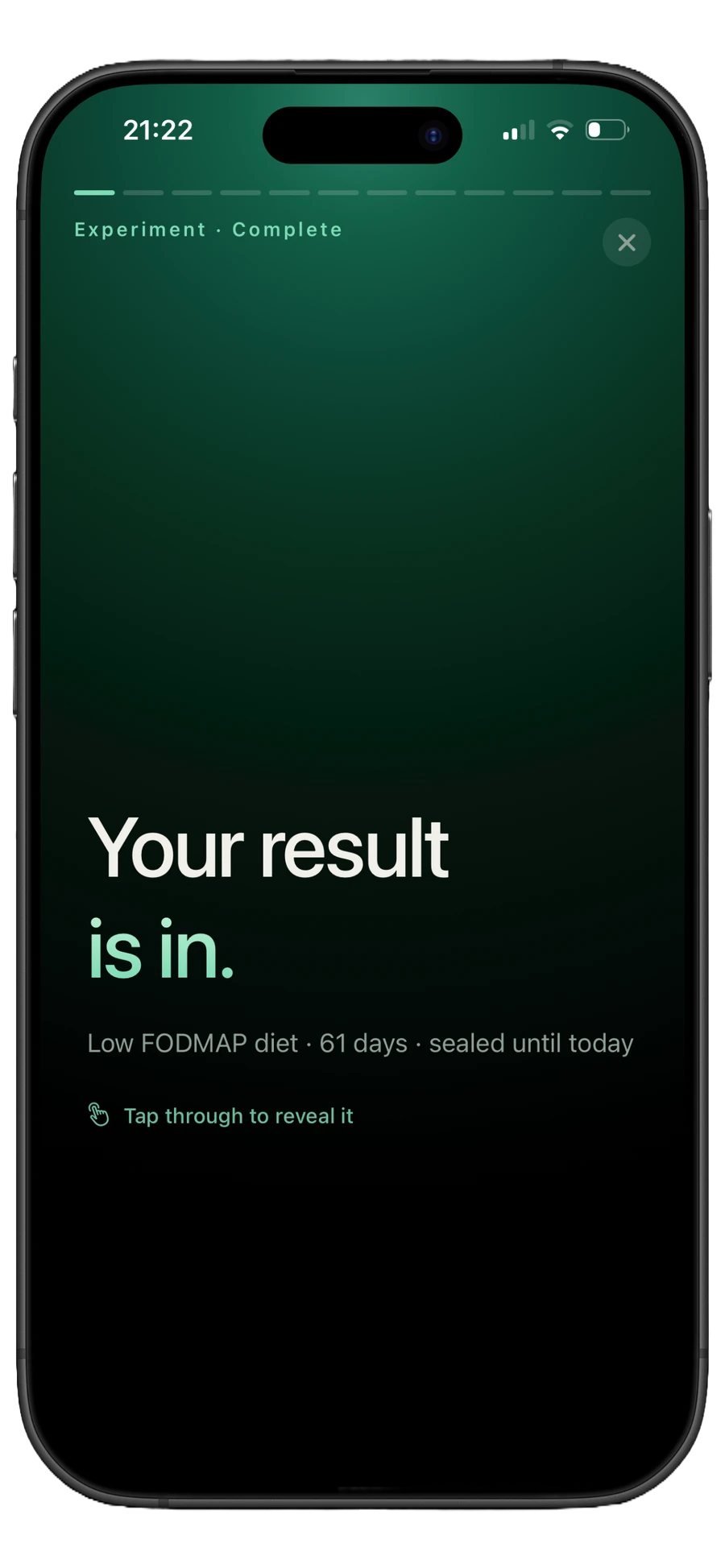
Elimination diets fail for a boring reason.
Most of them change three things at once, for as long as you can stand it, and then get judged on how you remember feeling. No experiment built that way can produce an answer — and after weeks of effort you are exactly where you started, minus the bread.
So Gutli runs it properly.
Four steps. The third one is the part almost nobody finishes, and it is the part that turns a suspicion into a finding.
Pick one thing to test
Onion, garlic, dairy, gluten, eggs, coffee, soy or alcohol. You choose the variable before day one, and it stays locked for the whole run. That is the entire difference between an experiment and a hunch.
Log the way you already do
Photograph a meal, log a symptom, rate the day. The food log, symptom log and journal work exactly as they always did — the experiment reads them. There is no second diary.
Put it back
This is the part elimination diets skip. Taking a food out shows that something changed. Putting it back is what pins the change to the food. Gutli runs that challenge and measures it against your own baseline.
Get a result with its reasoning attached
How many days actually counted. How closely you stuck to it. And what else was going on — the week you were ill, the trip, the nights you drank — that could explain the same change.
What you get out of it.
Know what your gut reacts to — and what it doesn’t
Most people cut far more than they need to, and never put anything back. Half the value of a finished experiment is the food you get to eat again.
Know it was the food, and not just a bad week
Illness, medication changes, stress, poor sleep, travel, alcohol and caffeine are tracked and weighed against your result, instead of quietly contaminating it.
Build a record you can rely on
Every finished run adds to a map of your own gut that carries into the next experiment — and into the next conversation with your doctor.
It will tell you when it doesn’t know.
Gutli grades its own confidence and shows you the grade. Take a food out, feel better, and you have reached Emerging — something changed, but plenty changed alongside it. Only a completed reintroduction, out and then back in, reaches Likely.
- Possible
- Emerging
- Likely
- Tested
Nothing reaches Tested today. That rung needs a validated symptom instrument we have not built, and handing it out early would make the whole scale worthless. An inconclusive result is a real result too, and you will get one when that is the truth.
Gutli does not diagnose anything. There are a handful of symptoms it asks about before you start and points you to a GP for, because some gut symptoms have serious causes.
Start with one food.
Test one food
Day 22
Onion, garlic, dairy, gluten, eggs, coffee, soy or alcohol. Five days eating normally to set your baseline, ten days without it, then seven days bringing it back to check. The narrowest possible question, which is why it gives the cleanest possible answer.
Low FODMAP, run properly
Coming soon
A planned experiment covering the full elimination with tracked adherence, followed by fructans, GOS, lactose, fructose, sorbitol and mannitol challenged back one group at a time. You can’t start it yet.
Eating window
Coming soon
Not what you eat but when. You can see it in the app; you can’t start it yet.
Your first run gets a longer baseline — five days of eating normally before anything is removed, because everything after it is measured against those days. Testing runs to a fixed window and can extend up to double it if your logging has been too patchy to read: 20 days at most on a single food. Reintroduction is opt-in. Skip it and a single-food run ends at day 15, but the result stays at Emerging.
Questions
Does Gutli diagnose anything?
How much work is this each day?
Do I have to log differently during an experiment?
What if I have a bad week in the middle of a run?
Does it use AI?
What happens to my data?
Still stuck? Get in touch.
Stop guessing.Start experimenting.
You already know which food you suspect. Twenty-two days from now you could know whether you were right.
Not a medical device. Not medical advice.